1068
 Request Call Back
 Contact
 1068
Gallbladder Polyps: When Do They Need Surgery
Published on: Oct 13, 2026
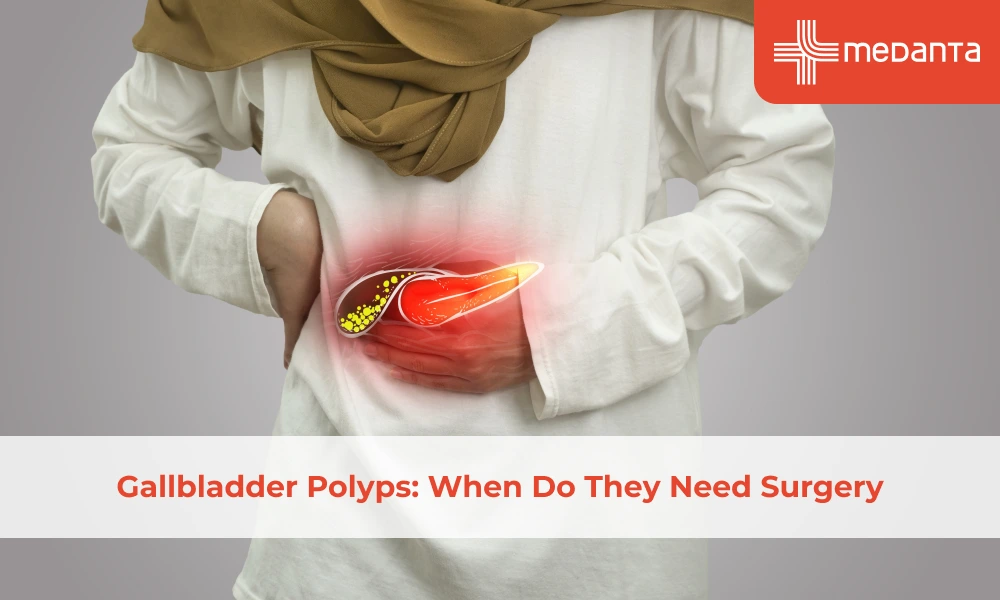
TABLE OF CONTENTS
- Types of Gallbladder Polyps
- Common Causes and Risk FactorsGallbladder
- Gallbladder Polyp Size and Cancer Risk
- Symptoms Associated With Gallbladder Polyps
- How Gallbladder Polyps Are Diagnosed
- When Doctors Recommend Monitoring
- When Surgery May Be Recommended
- Types of Gallbladder Surgery
- Follow-Up After Detection of a Gallbladder Polyp
- FAQs
- References
What Are Gallbladder Polyps?
Gallbladder polyps are projections of tissue from the inner wall of the gallbladder. They are discovered incidentally on abdominal ultrasound in many adults and are usually benign. However, a small proportion carry a risk of malignant transformation and determining which polyps require surgery and which can be safely monitored is a common clinical challenge.
Types of Gallbladder Polyps
Different types are:
Cholesterol polyps: The most common type, accounting for 60 to 70% of all gallbladder polyps. These are lipid deposits within submucosal macrophages and are not true neoplasms. They are typically small (below 10 mm), multiple, pedunculated and carry no malignant potential.
Adenomatous polyps: True neoplastic polyps arising from the glandular epithelium of the gallbladder. Adenomas carry a risk of malignant transformation and are the type most concerning for developing gallbladder carcinoma.
Common Causes and Risk FactorsGallbladder
polyps can develop for several reasons with most being benign cholesterol deposits, whereas certain conditions and patient factors may increase the risk of clinically significant polyps. They are:
Cholesterol metabolism and metabolic syndrome: Patients with dyslipidaemia, obesity, type 2 diabetes and fatty liver disease (conditions that constitute metabolic syndrome) are at higher risk of cholesterol polyp formation.
Hepatitis B virus (HBV) infection: HBV has been identified as an independent risk factor for gallbladder polyps in multiple Asian studies.
Gallstones: The coexistence of gallstones and gallbladder polyps is common. Gallstones create an inflammatory environment in the gallbladder that may promote polyp formation. They also complicate ultrasound assessment of polyp characteristics.
Gallbladder Polyp Size and Cancer Risk
Polyp size is the single most important determinant of malignancy risk. Polyps above 10 mm carry a significantly elevated risk of harbouring or developing gallbladder carcinoma and current guidelines (ESGAR/ESGE) recommend cholecystectomy for all polyps 10 mm or above. Polyps between 6 and 9 mm represent an intermediate risk zone.
Symptoms Associated With Gallbladder Polyps
Gallbladder polyps often stay silent but when symptoms do show up, they tend to follow a familiar pattern.
Pain or discomfort in the upper right abdomen
Nausea, especially after eating fatty foods
Bloating or a feeling of fullness
Occasional vomiting
Jaundice, in rare cases where a polyp blocks bile flow.
How Gallbladder Polyps Are Diagnosed

The majority of benign gallbladder polyps are found accidentally during ultrasound for other reasons. After that doctors suggest further investigations to confirm the diagnosis. Investigations are:
Transabdominal ultrasound: The primary imaging modality for detecting gallbladder polyps. It is non-invasive, inexpensive and accurately identifies the presence, number, size, and morphology (pedunculated versus sessile) of polyps.
Endoscopic ultrasound (EUS): Provides higher-resolution images of gallbladder polyps than transabdominal ultrasound and is particularly useful for characterising intermediate-risk polyps (6 to 9 mm) and for distinguishing cholesterol polyps from adenomas or malignant lesions.
When Doctors Recommend Monitoring
The majority of patients with gallbladder polyps do not require surgery. Conservative monitoring with serial ultrasound is appropriate in the following circumstances.
Polyps below 6 mm with no high-risk features: These are very likely to be cholesterol polyps and carry negligible malignancy risk. They are followed with ultrasound at 6 months, 12 months and then every 2 years if stable.
Polyps 6 to 9 mm without additional high-risk features: These require more frequent surveillance typically every 3 to 6 months initially, with surgery recommended if growth exceeds 2 mm or high-risk morphological features develop.
Patients who are poor surgical candidates because of significant comorbidities may be monitored rather than operated on even for polyps approaching 10 mm, after individualised risk-benefit discussion.
When Surgery May Be Recommended
Cholecystectomy (surgical removal of the gallbladder) is recommended in the following situations.
Polyp size 10 mm or above: This is the single most important threshold for recommending surgery, based on the substantially elevated malignancy risk at this size. All patients with polyps 10 mm or above should undergo cholecystectomy unless there are strong contraindications to surgery.
Rapid polyp growth: An increase of 2 mm or more on serial ultrasound, regardless of the absolute size, is an indication for surgery.
Sessile polyp morphology with intermediate or high-risk features: A sessile polyp (particularly one 6 to 9 mm) with concurrent gallstones, patient age above 50 or primary sclerosing cholangitis should be considered for cholecystectomy.
Symptomatic polyps: When symptoms are attributable to the polyp rather than to coexisting pathology and conservative management has not provided adequate relief, cholecystectomy may be appropriate.
Patient anxiety or preference: Some patients with intermediate-risk polyps elect surgery after being counselled about the low but real risk of malignancy, particularly in regions with a high background incidence of gallbladder carcinoma such as the Gangetic belt.
Types of Gallbladder Surgery
Different types are:
Laparoscopic cholecystectomy: The gold standard surgical approach for gallbladder polyps. Performed under general anaesthesia through three to four small abdominal incisions. The gallbladder is removed and sent for histopathological examination. Hospital stay is typically one to two days.
Open cholecystectomy: Involves a single larger incision and is generally reserved for complicated cases, such as severe inflammation, scarring from previous surgeries or when a laparoscopic approach needs to be converted mid-procedure.
Robotic-assisted cholecystectomy: Uses robotic technology to give the surgeon greater precision and control particularly useful in more complex or delicate cases.
Follow-Up After Detection of a Gallbladder Polyp
After a gallbladder polyp is detected, the follow-up schedule is guided by the size and characteristics of the polyp and by the patient's individual risk profile.
Polyps below 6 mm with no risk factors: Ultrasound at 6 months and 12 months then every 2 years if stable. Discharge from surveillance after 5 years with no growth is reasonable.
Polyps 6 to 9 mm: Ultrasound every 3 to 6 months for the first year then every 6 to 12 months thereafter if stable. Surgery is recommended if the polyp reaches 10 mm or if rapid growth or morphological change occurs.
After cholecystectomy: The resected specimen is always sent for histopathological examination to determine the true nature of the polyp. If histopathology confirms an incidental gallbladder carcinoma, the patient requires oncological staging and multidisciplinary review for further management. No routine imaging follow-up is required after cholecystectomy for a confirmed benign polyp.
FAQs
Are gallbladder polyps usually cancerous?
The majority of gallbladder polyps are benign. Cholesterol polyps account for over 60% of all polyps and carry no malignant potential. The risk of malignancy increases with polyp size, particularly for polyps above 10 mm.
Can gallbladder polyps disappear on their own?
Yes cholesterol polyps, which are lipid deposits rather than true neoplasms, can spontaneously regress or disappear on follow-up ultrasound. True adenomatous polyps and hyperplastic polyps do not typically disappear.
How quickly can a gallbladder polyp grow?
Benign polyps typically grow slowly at less than 1 to 2 mm per year. Rapid growth of more than 2 mm per year is considered a high-risk feature and is an indication for cholecystectomy, regardless of the absolute polyp size.
Can gallbladder polyps cause abdominal pain?
Gallbladder polyps themselves rarely cause symptoms. When right upper quadrant pain, bloating or nausea are present alongside gallbladder polyps, they are more often attributable to coexisting gallstones or biliary dyskinesia than to the polyps themselves.
What happens if a gallbladder polyp is left untreated?
Most small benign polyps can be safely monitored with periodic ultrasound without treatment. If a polyp grows above 10 mm, develops high-risk features (rapid growth, sessile morphology) or causes symptoms, surgery (cholecystectomy) is recommended.
How often should gallbladder polyps be checked?
Surveillance depends on polyp size. Polyps below 6 mm are followed at 6 and 12 months, then every 2 years. Polyps 6 to 9 mm are followed every 3 to 6 months. Polyps 10 mm or above require surgical evaluation.
Can diet reduce the risk of gallbladder polyps?
No specific diet has been shown to cause or prevent gallbladder polyps. However a low-fat, low-cholesterol diet may reduce the accumulation of cholesterol in the gallbladder wall, potentially reducing the growth of cholesterol polyps.
Is laparoscopic surgery possible for gallbladder polyps?
Laparoscopic cholecystectomy is the standard surgical approach for gallbladder polyps requiring surgery. It involves three to four small incisions, a hospital stay of one to two days and faster recovery than open surgery.
How long can someone live with a gallbladder polyp?
Most people with small gallbladder polyps live a normal life without any complications. Malignant transformation is rare and is almost exclusively limited to adenomatous polyps above 10 mm. Long-term monitoring with ultrasound surveillance is sufficient for low-risk polyps.
Are multiple gallbladder polyps more concerning than a single polyp?
Multiple polyps are less likely to be malignant than a single solitary polyp. Multiple small polyps are typically cholesterol polyps and are benign. A single sessile polyp above 10 mm carries a higher malignancy risk and warrants surgical intervention.
References
1. Foley KG, Lahaye MJ, Thoeni RF, et al. Management and follow-up of gallbladder polyps: updated joint guidelines between the ESGAR, EAES, EFISDS and ESGE. Eur Radiol. 2022;32(5):3358-68. https://doi.org/10.1007/s00330-021-08384-w
2. Boulton R, Adams DH. Gallbladder polyps: when to wait and when to act. Lancet. 1997;349(9063):1365. https://doi.org/10.1016/S0140-6736(97)24014-6
3. Wiles R, Thoeni RF, Barbu ST, et al. Management and follow-up of gallbladder polyps: joint guidelines between the European Society of Gastrointestinal and Abdominal Radiology (ESGAR), European Association for Endoscopic Surgery and other Interventional Techniques (EAES), International Society of Digestive Surgery-European Federation (EFISDS) and European Society of Gastrointestinal Endoscopy (ESGE). Eur Radiol. 2017;27(9):3856-66. https://doi.org/10.1007/s00330-017-4742-y
4. Shukla VK, Rastogi AN, Adukia TK, et al. Organochlorine pesticides in carcinoma of the gallbladder: a case-control study. Eur J Cancer Prev. 2001;10(2):153-6. https://doi.org/10.1097/00008469-200104000-00007
5. Singh A, Shukla VK. Gallbladder cancer: an overview. Indian J Surg. 2011;73(5):330-6. https://doi.org/10.1007/s12262-011-0316-x